
The community booklet, made live
A Parichay Pustika that stays current—and respects each family's privacy
How Famintro's free digital Parichay Pustika turns a static event booklet into a focused, searchable and family-controlled way to discover suitable introductions.
Reviewed by the Famintro Team ·
 Famintro perspective
Explore live editions
Browse active digital Parichay Pustikas and discover focused profiles with clear access rules.
What a focused edition could look like
Three realistic examples
These are illustrative examples, not currently active editions. A clear scope helps families spend time on relevant introductions instead of scanning an unfocused catalogue.
Doctors Pustika · Ages 26–34
Active candidates across MBBS, MD/MS, BDS and other medical professions. Families could narrow by specialization, age, current city and relocation openness.
Helps with: relevant discovery around demanding medical careers and location realities.
CA Pustika · Ages 27–36
Chartered accountants in practice, employment, finance leadership or a family business. City and work-type filters could help families understand lifestyle context.
Helps with: useful career context beyond the single label of ‘CA’.
NCR & Nearby · Ages 25–35
Candidates living in—or open to moving to—Delhi, Gurugram, Noida, Ghaziabad and Faridabad. Families could also filter by profession, samaj and parents’ location.
Helps with: a practical regional search without splitting nearby cities into separate books.
The short answer
Direct answer
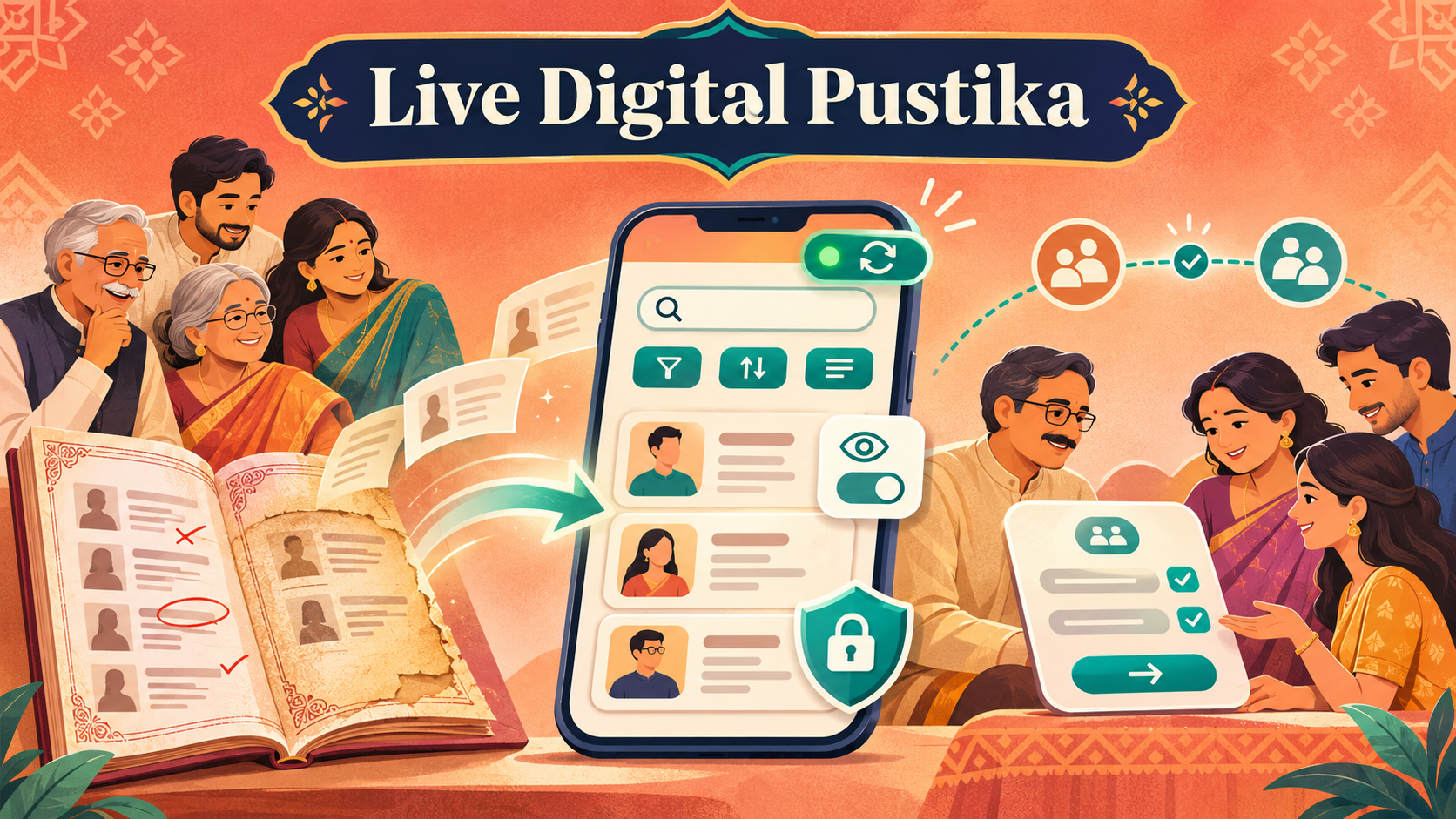
A digital Parichay Pustika keeps the useful community focus of a traditional samajik parichay sammelan booklet while solving its most difficult limitations. Families can choose to be included or hidden, information can be corrected or updated, and direct contact details stay private. Other families can search, filter, sort, view highlights and send a structured connection request through Famintro—all without paying to list or buy a booklet.
The printed pustika has played an important role
Many samajik parichay sammelan events publish a Parichay Pustika so participating families can discover candidates within a trusted community context. Families often pay to add a profile, and parents may buy the printed booklet to find and contact other families. It has helped introductions travel beyond the event itself.
The limitation is not the community idea; it is the fixed format. Once ink reaches paper, the information cannot respond when a family's circumstances change.
A life update should not wait for the next print run
A spelling mistake, incorrect detail or printing error is difficult to fix in every copy already distributed. More importantly, a candidate may become engaged or decide to pause the search while their phone number continues circulating. The family can still receive calls long after the listing is no longer relevant.
A live edition gives the family and Famintro a practical way to correct information, update the listing or hide it. This reduces avoidable noise for both the listed family and parents trying to understand which introductions are genuinely active.
Share enough to help—not everything with everyone
A useful introduction needs relevant candidate and family context. It does not require publishing a personal phone number, address or every sensitive detail to an unknown audience. Famintro's digital pustikas are designed to present a focused set of profiles while keeping key contact details private.
Families retain a meaningful choice: they can ask to participate in a suitable pustika or ask for their information to be hidden. Individual editions may also be open or limited to approved Famintro families, and their access policy is shown clearly.
A directory you can actually explore
Instead of scanning every page in the same order, readers can search the current edition and narrow it with filters such as age, profession and community. Sorting helps families review the list in a useful sequence, while the highlights view offers a quick visual overview of participating profiles.
When a profile seems relevant, the next step is not an exposed phone number. A family can express interest through a secure, structured form so Famintro can help the matching families connect with greater context and consent.
Focused editions reduce noise
A very large, undifferentiated catalogue can make a matrimonial search harder rather than easier. Each digital pustika can focus on a relevant set of candidates, helping families spend attention on introductions that fit the edition's purpose.
Because the list is digital, an edition can have a clear availability period and reflect a more current pool. That makes it easier to understand what is active now instead of treating an old printed record as permanent truth.
Free for the families it is meant to help
Famintro does not charge a family to be included in an appropriate digital pustika, and another family does not need to buy a book to explore the active editions. Searching, reviewing and sending a connection request are offered without cost to families.
The aim is simple: help families connect transparently and securely, preserve the value of community-led introductions, and remove the cost and avoidable exposure created by a static printed directory.
Common questions
Frequently asked questions
What is a digital Parichay Pustika?
It is a live, focused directory of matrimonial profiles that families can search, filter and review online. Unlike a printed booklet, its information can be corrected, updated or hidden.
Does Famintro publish phone numbers or addresses in the pustika?
The digital pustika is designed to keep key direct-contact details private. Interested families use a structured Famintro form to request a connection.
Can a family remove or hide its information?
Yes. Family choice is central to the feature: a family can choose to participate in a suitable edition or ask for its information to be hidden.
Is it free to be listed or contact a matching family?
Yes. Famintro offers pustika inclusion and secure connection requests free for families.
What can readers do inside a pustika?
Readers can search, apply filters, change the sorting, browse the book view, watch profile highlights and express interest through a secure form.
Who can open a digital pustika?
Access depends on the edition. Some are open, while others are reserved for signed-in families with an active, approved Famintro profile. The active-editions page labels the access level.