
From more choices to better conversations
Too many matrimonial profiles? How families can overcome analysis paralysis
Why endless matrimonial choices can delay decisions—and how personalized best-fit reasons, practical filters and a focus on personality compatibility can help.
Reviewed by the Famintro Team ·

 Famintro perspective
The short answer
Direct answer
More matrimonial profiles do not automatically make finding a partner easier. When every option leads to another option, families can postpone conversations, compare people on increasingly minor criteria and lose valuable time. Based on one-to-one conversations with several hundred families and interactions through Famintro parichay sammelans, Famintro organizes each family's search around its own profile and preferences, presents promising possibilities first, explains why a profile may fit and provides filters and sorting tools for further refinement. These are navigation aids—not a substitute for personal judgment, verified information or genuine compatibility.
Inside Famintro
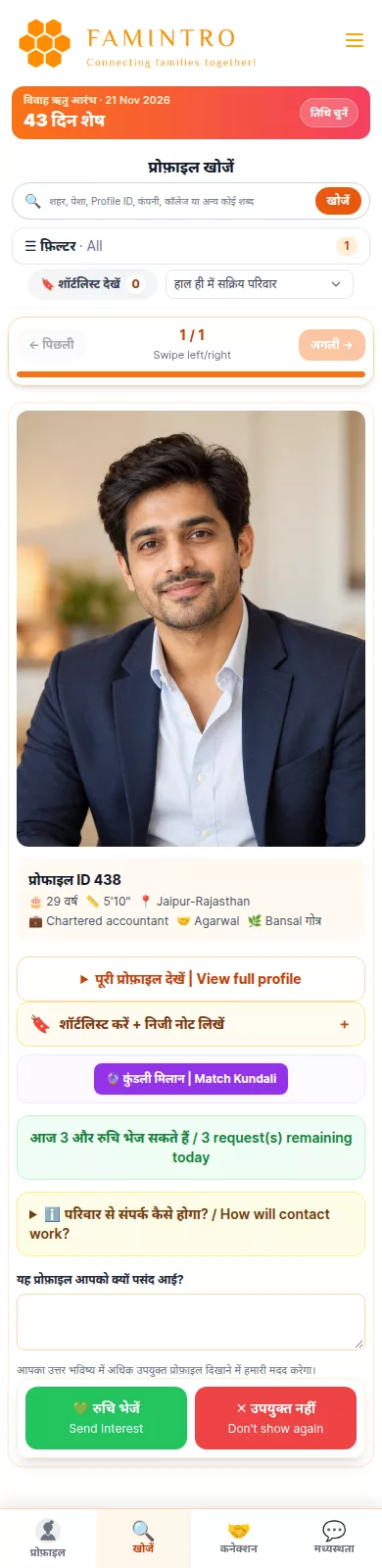
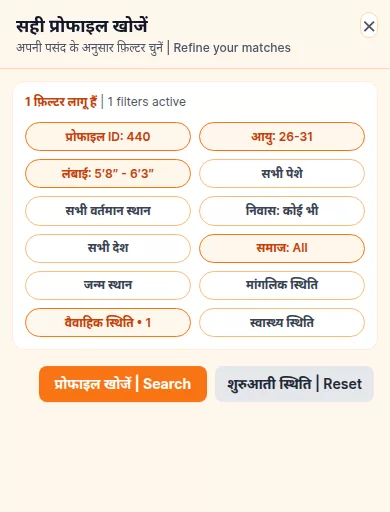
See the feature in the actual app
Why more choice can make a decision harder
A large pool may feel reassuring at first. But when families believe an even better profile could always appear on the next screen, they may keep browsing instead of beginning a meaningful conversation. Suitable people can be reduced to a checklist, small differences gain too much importance and every decision becomes easy to postpone.
This is commonly called analysis paralysis or choice overload. It does not mean families should accept a match quickly or ignore important requirements. It means the search needs enough structure to turn possibilities into thoughtful next steps.
What families have taught us
Famintro's approach has been informed by one-to-one conversations with several hundred families and by questions raised during the parichay sammelans we host. Different families begin with different realities: age, location, profession, community, family structure, career plans and other circumstances can all change what is practical.
A useful search should therefore adapt to the family rather than give every family the same undifferentiated catalogue. The aim is to help people spend attention on a manageable set of relevant possibilities from the day they register, while leaving the final judgment entirely with the two people and their families.
Start with promising possibilities
Famintro uses the information and preferences available for a family to order search results so that likely relevant profiles can appear earlier. This saves repeated screening and helps a newly registered family understand where to begin.
Best fit does not mean perfect fit, verified compatibility or a recommendation to marry. Profile information may be incomplete or change over time. Important details should be confirmed, and no ranking can predict whether two people will feel comfortable together.
See why a profile may fit
A search result can explain relevant overlaps, such as preferred age, location, profession or another stated preference. Showing the reason makes the result more transparent than an unexplained score and helps a family decide whether to open the full profile.
These reasons describe data-based alignment, not a person's character or the quality of a future relationship. Families should treat them as a starting point for attention and conversation.
Use filters and sorting without building a cage
Straightforward filters and sorting orders let families narrow a broad result set around practical needs. They can also relax a preference when the result set has become too small. This is often more useful than repeatedly scanning profiles that could never meet a non-negotiable circumstance.
It helps to separate true constraints from preferences. A location responsibility or essential life goal may require early discussion; a narrowly defined title, height or city preference may deserve more flexibility when the person otherwise seems promising.
Personality compatibility remains the real test
Famintro recommends using search tools to decide whom to understand—not to decide whom to marry. After a sensible shortlist, the more important questions concern values, emotional maturity, communication, respect, temperament and whether both people can imagine solving life's problems together.
When two people feel genuinely connected and can communicate openly, many practical questions become easier to discuss. That connection should never override safety, consent or a serious incompatibility, but it is often more meaningful than optimizing an endless list of surface-level choices.
Choose a next step, not a final verdict
A profile does not need to answer every question before a family expresses interest. A useful rhythm is to review the full information, note a few important questions and take one respectful next step. Shortlist, connect or move on—but avoid leaving every possibility permanently undecided.
The goal is not speed for its own sake. It is to protect the family's most precious resource—time—while giving suitable people a fair chance to be understood.
Common questions
Frequently asked questions
What is analysis paralysis in matrimonial search?
It is the difficulty of taking a next step because there are too many profiles, comparisons or criteria to evaluate. Families may keep browsing even when a promising possibility is already available.
Does Famintro's best-fit order guarantee compatibility?
No. It prioritizes potentially relevant profiles using available family information and preferences. It cannot guarantee accurate profile details, personal chemistry or relationship success.
Why does Famintro explain why a profile may fit?
The explanation identifies relevant preference overlaps so families can understand why a result appeared and decide whether it deserves closer review.
Should families use every available filter?
Not necessarily. Use filters for meaningful constraints, then keep flexible preferences open enough to avoid excluding a compatible person.
What matters after creating a shortlist?
Direct conversation about values, temperament, communication, life goals and mutual respect matters more than continuing to optimize a list of profiles.